
It is still critical that a business invests in a well-made website. A lot of what a company achieves online comes from a modern website that works properly on every device, ranks well in search, and answers the questions customers actually have.
The honest answer to "how much does a website cost" is that it depends on what the site has to do. But that answer is useless on its own, so here are the real numbers, what drives them up and down, and the costs most quotes leave out.
Quick answer
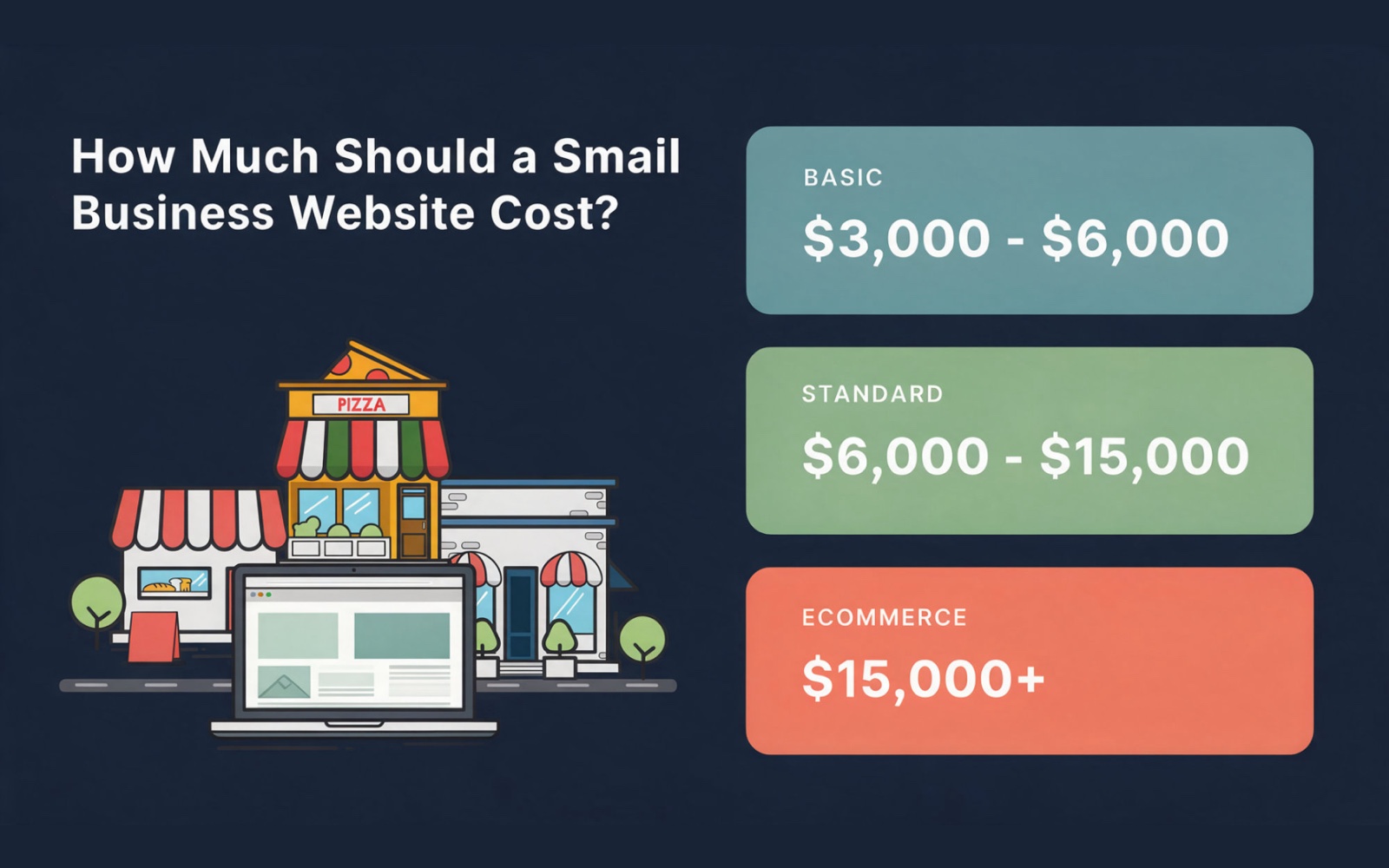
| Type of website | Typical range | What you get |
|---|---|---|
| DIY builder | $200 - $800 per year | Template site you build and maintain yourself |
| Small informational site | $3,000 - $6,000 | Five to ten pages, mobile ready, basic SEO, contact form |
| Standard business site | $6,000 - $15,000 | Custom design, blog, deeper SEO, analytics, room to grow |
| eCommerce or custom build | $15,000 and up | Payments, accounts, integrations, custom functionality |
Those are project costs. Running costs come on top, and we will get to those, because they are the part people forget to budget for.
The costs that are fixed no matter who builds it
Domain name
You need a domain like www.mycompanyname.com so your site can be found. A brand new domain costs around $12 to $20 a year depending on the registrar and the extension.
An existing domain that someone already owns is a different market. Expect hundreds or thousands, and occasionally far more. Worth checking early if you have your heart set on a particular name.
Hosting
Your website needs a server so people can reach it. There are three common options:
| Type | Typical cost | Good for |
|---|---|---|
| Shared hosting | $5 - $15 per month | Small informational business sites |
| Managed WordPress | $20 - $50 per month | Business sites where uptime and updates matter |
| VPS or cloud | $20 - $80 per month | Busier sites and small online stores |
| Dedicated server | $100+ per month | Large sites with heavy traffic |
Hosting fees are almost never included in design and development costs, so treat them as a separate line in your budget. Your developer should help you pick the right tier rather than defaulting to the cheapest.
One thing that has changed: SSL certificates are now free. If anyone quotes you a yearly fee for a basic certificate, ask why.
Web design and web development are not the same thing
Before the numbers make sense, it helps to separate the two.
Website design
Web design is the process of designing the site in visual form. Think of it as turning an idea, or a story, into something people want to look at and can find their way around. Just as an architect draws the plans before anyone pours concrete, a designer lays out the site before a developer builds it.
Web development
Developers turn the design into a working website. Front-end developers use HTML, CSS, and JavaScript to build what you see, and set up a content management system so you can make changes without writing code. Back-end developers use languages like PHP, Ruby, or Python to build the parts that do things: logins, checkouts, payment processing, and anything that talks to another system.
Web Design + Web Development = Awesome Website
Design and development together are the heart of the project. Design settles the colours, images, and structure. Development decides the technology, the SEO foundations, and how the site will hold up as you grow.
It is worth knowing that supplying your own photos, videos, and written content reduces the cost of the project, sometimes considerably. It is also the most common reason a project runs late, so if you are providing it, get it ready before the build starts.
What actually moves the price
- Number of pages. A five-page site and a fifty-page site are different projects.
- Custom design versus a template. A template is cheaper and faster. A custom design looks like you rather than like everyone else using that template.
- Functionality. Payments, bookings, memberships, and integrations with software you already use all add real development time.
- Content. Copywriting and photography are genuine costs. If you are not writing it, someone is being paid to.
- SEO depth. Basic technical setup is one thing. Keyword research, location pages, and a content plan are another.
- Integrations. Connecting your CRM, email platform, or inventory system is often where the hours go.
The costs most quotes leave out
This is the section we wish more people read before signing anything.
| Ongoing cost | Typical range |
|---|---|
| Hosting | $60 - $600 per year |
| Domain renewal | $12 - $20 per year |
| Maintenance and updates | $50 - $300 per month |
| Premium plugins or licences | $100 - $500 per year |
| Content and SEO work | Varies widely |
Maintenance is the one people skip, and it is the one that hurts. A WordPress site needs its core, theme, and plugins updated regularly. Out-of-date plugins are the most common way small business sites get hacked, and cleaning up after that costs far more than preventing it.
What about Squarespace, Wix, or Shopify?
They are legitimate options and worth being honest about. For roughly $200 to $800 a year you get hosting, templates, and an editor, with no build cost.
The trade-off is ceiling rather than quality. You are working inside what the platform allows, custom functionality is limited, and moving off later usually means rebuilding. For a business testing an idea, a builder is often the sensible first step. For a business where the website is a main source of enquiries, the limits tend to show up within a year or two.
Why the same website gets three very different quotes
If you ask three people to build the same site, you may well hear $2,000, $8,000, and $25,000. Usually they are not quoting the same thing.
The cheapest quote is often a template with your logo dropped in, no content work, no SEO, and no support afterwards. The most expensive may include research, custom design, copywriting, and a maintenance agreement. Neither is dishonest. They are different products.
The useful question is not "how much" but "what is included, and what happens after launch". Ask for that in writing and the quotes become comparable.
Is it worth it?
Work out what one new customer is worth to you over a year. Then work out how many the site needs to bring in before it has paid for itself. For most businesses that number is small, and it reframes the decision from a cost into a payback period.
A website that never converts is expensive at any price. One that brings in steady enquiries is cheap even at the top of the range.
Bottom Line
Most small business websites land between $3,000 and $15,000, depending on size, custom work, and how much content you supply. Budget for running costs on top, and treat maintenance as part of the project rather than an optional extra.
Whatever you decide, plan to invest in a well-made website that gives you back more than you spent on it.
If you would like a straight answer for your own situation, tell us what you are trying to build and we will tell you what it takes.