

If you have been trying to get gold stars to appear under your business in Google search results, the real answer is messier than either side of the argument admits. Google's own rules say reviews you host about yourself do not qualify. Its results page does not always agree.
This post used to explain how to build exactly that, and the instructions worked when they were written. Google restricted the feature in September 2019 and most sites lost their stars. A few never did. So this is the version that gives you the rule, what actually happens, and where your reviews show up reliably.
What Google changed
Google calls it the self-serving review rule, and the wording in its documentation is direct:
"If the entity that's being reviewed controls the reviews about itself, their pages that use LocalBusiness or any other type of Organization structured data are ineligible for star review feature."
Read literally, that means a plumber cannot collect reviews on their own website, mark them up with AggregateRating, and get stars. Neither can a lawn care company, a dentist, a law firm, or a web design agency. The markup is not an error and nothing gets penalised. The stars just do not appear.
The reason for the change is obvious once you see the old results. Everybody gave themselves five stars.
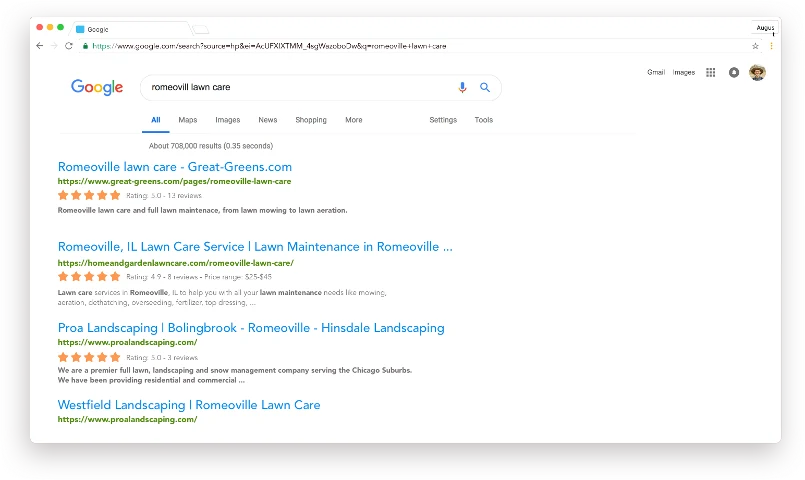
Except that some sites still have them
This is where most advice on the subject goes wrong, in both directions. Search for a local service today and you will still see star ratings in the ordinary results, and they are not all coming from directories or product pages.
LawnStarter's page for Romeoville is a plain example. The page carries one block of structured data:
{
  "@type": "LocalBusiness",
  "aggregateRating": {
    "ratingValue": 4.85,
    "reviewCount": 92
  }
}
A LocalBusiness, on its own site, rating itself, from 92 reviews it collected. That is exactly the combination the guideline calls ineligible, and Google shows the stars regardless.
The rule is real and it is applied to most sites. It is not applied to all of them, and Google has never explained the difference. So treat self-hosted review stars as something that might happen to you, not something you can build on. If they show, good. If they never show, there is nothing to fix and nobody to ask.
Who Google says can get review stars
On paper the feature was not removed, only restricted to cases where the reviewer and the reviewed are not the same party. This is the list Google publishes:
| Eligible | Not eligible |
|---|---|
| Products you sell | Your own business, reviewed on your own site |
| Recipes, books, movies, courses, events, software | LocalBusiness reviewing itself |
| A directory reviewing other businesses | Organization reviewing itself |
| Reviews you genuinely collected about someone else | Reviews copied from Google or Yelp onto your site |
So an online shop can still show stars on a product page, because the product is a separate thing from the shop. A recipe blog can still show them. A site that reviews local contractors can show them for the contractors it reviews. Your own services page cannot show them for you.
Where your reviews actually appear now
They did not disappear from search. They moved.
For a local business, reviews show in the map pack, the box of three businesses that sits above the ordinary results, and in the panel that appears when someone searches your name. Both are fed by your Google Business Profile, not by your website.
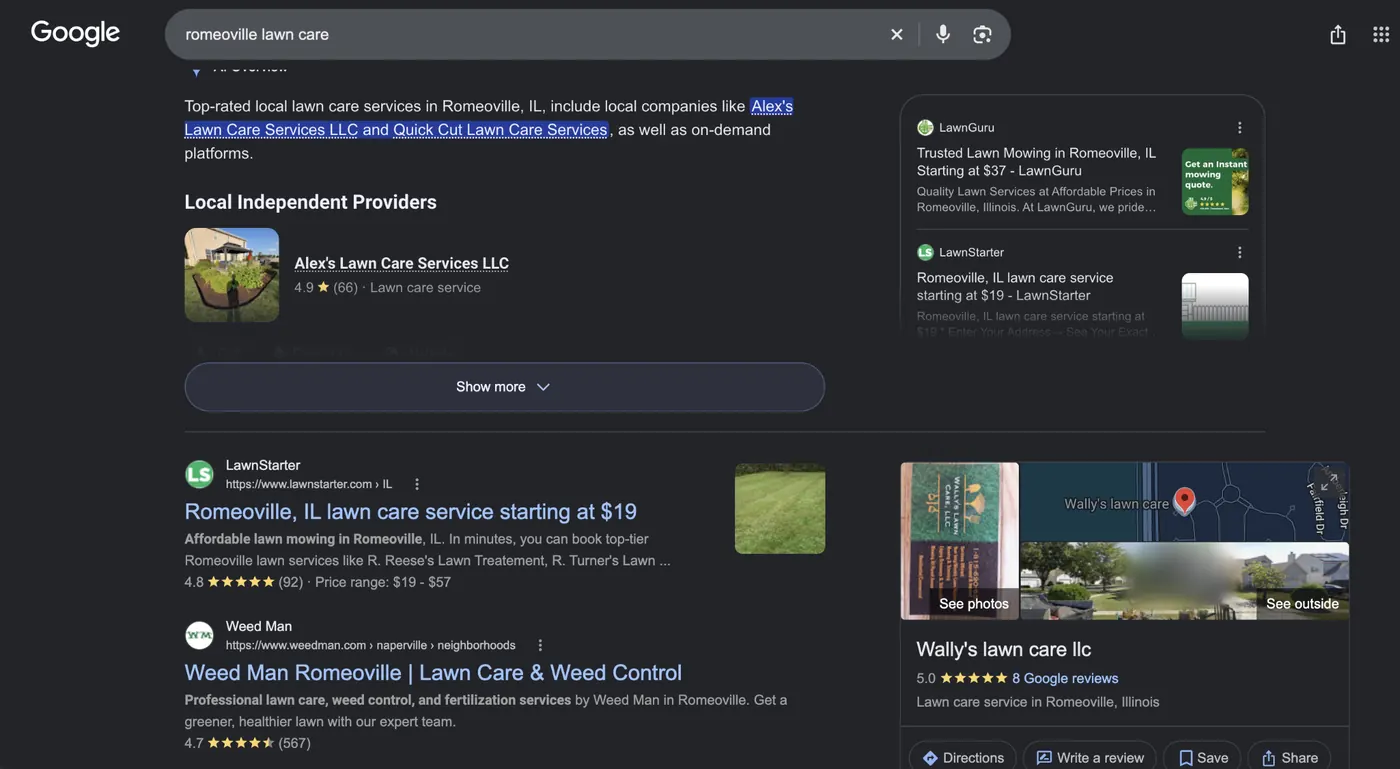
That is a better outcome than the old system, even though it feels like a loss. Profile reviews are written by customers on a platform you do not control, which is exactly why searchers trust them, and they show on the most valuable piece of screen space in a local search.
Claim the profile, fill it in properly, and then ask customers to leave reviews there. Reply to all of them, including the bad ones, because the reply is read by every future customer. This is the highest-return work available to a local business, and we covered the whole picture in how to optimize a local business website.
Should you still put reviews on your website?
Yes. Just not for stars.
Reviews on your own site still do real work: they convince the person already reading your services page, they give your city pages the local proof that keeps them from looking templated, and they are content nobody else has. That is a conversion job, not a search job.
Two things worth getting right:
- Do not copy reviews from Google or Yelp onto your site. It breaks those platforms' terms and it is not content you own. Quote a line with a link, or ask the customer directly for a testimonial you can use.
- Do not mark them up with
AggregateRatinghoping the rule changed. It has not, and markup that claims an ineligible feature is the kind of thing you do not want accumulating across a site.
If you do qualify, here is the markup
For a product, a course, an event or anything else on the eligible list, the structured data is straightforward. Keep it to what is true:
<script type="application/ld+json">
{
  "@context": "https://schema.org",
  "@type": "Product",
  "name": "Cordless Hedge Trimmer HT-400",
  "image": "https://example.com/images/ht-400.jpg",
  "description": "18V cordless hedge trimmer with a 52cm blade.",
  "aggregateRating": {
    "@type": "AggregateRating",
    "ratingValue": "4.6",
    "reviewCount": "38"
  }
}
</script>
The rating has to match what is visible on the page. If the page shows 38 reviews averaging 4.6, the markup says 38 and 4.6. Inventing numbers, or marking up an average that appears nowhere on the page, is the specific abuse that caused the restriction in the first place.
The old Structured Data Testing Tool is retired. Use the Rich Results Test to check whether a page is eligible for a given feature, and the Schema Markup Validator at validator.schema.org to check the syntax itself. They answer different questions, and for reviews the first one is the one that matters.
If you want the wider picture on structured data, including the types that are worth adding for a local business, that is in improve search engine rankings with structured data.
Bottom Line
Self-hosted review stars are not worth planning around. The rule says they should not appear, for most sites they do not, and where they still show nobody can tell you why or promise it lasts. Any guide presenting AggregateRating on your own business pages as a reliable tactic has not checked it since 2019.
Reviews still matter enormously for a local business. They just live on your Google Business Profile now, where customers write them and you reply to them, rather than on a testimonials page you control.
Open your Google Business Profile and count your reviews. If it is under ten, that is the single most valuable thing you could fix this month, and it costs nothing but asking.